


en
en v
Phone
Cart0 Tickets
Total: 0
Account
Calendar
Search
Menu

The Rhinegold

VenueGran Teatre del Liceu
CalendarSun 07 Feb 2027 - Sun 21 Feb 2027
Synopsis/Details


The Rhinegold – Richard Wagner

Epic opera in one act. Prologue to the tetralogy Der Ring des Nibelungen (The Ring of the Nibelung)

Libretto and music by Richard Wagner


The birth of power, its corruption and the fracture of an order that seemed eternal

With The Rhinegold, prelude to Der Ring des Nibelungen, Wagner opens a mythical universe that speaks directly to our present: the birth of power, its corruption and the fracture of an order that seemed eternal. In this new production, stage director Tobias Kratzer intertwines myth and modernity in a proposal full of poetic and unsettling images and turns the legend into a vibrant and absolutely contemporary theatrical experience.

The primordial gold, pure treasure of the Rhine, is profaned by the desire for dominion. With this gesture, Alberich —performed by Bo Skovhus— sets in motion a chain of deceptions that will shake gods and humans. At the center of the conflict, Wotan (Nicholas Brownlee), Fricka (Tanja Ariane Baumgartner) and the powerful Erda (Okka von der Damerau) reveal the tensions of a divine world that is breaking apart. The enigmatic presence of Loge (Nicky Spence), the unease of Mime (Mikeldi Atxalandabaso) and the strength of Fasolt (Ante Jerjunica) and Fafner (Wilhelm Schwinghammer) complete a Wagnerian cast of high dramatic intensity.


From the pit, Jonathan Nott unfolds all the symbolic power of the orchestra: the leitmotifs emerge as sonic archetypes that evoke water, greed, law, lost love. His conducting —precise, organic, deeply narrative— turns the score into a living organism that breathes with the drama.

Das Rheingold is not just the story of a ring: it is the beginning of a spiritual crisis. Love, nature and commitment are turned into currency, but in this darkness there also pulses a promise: the possibility of breaking the cycle of power and recovering what cannot be bought.

Thus, Wagner places us before a radical idea and a breathtaking beauty: that what is truly sacred is only reborn when reverence defeats domination and that, perhaps, we are still in time to return to the origin.


  • 🕒 Running time
    • approximately 2 hours 35 minutes
Cast

Wotan: Nicholas Brownlee

Donner: Daniel Scofield

Froh: Roger Padullés

Loge: Nicky Spence 

Alberich: Martin Winkler

Mime: Mikeldi Atxalandabaso

Fasolt: Ante Jerkunica

Fafner: Wilhelm Schwinghammer

Fricka: Tanja Ariane Baumgartner

Freia: Anett Fritsch

Erda: Okka von der Damerau

Woglinde: Ximena Agurto

Wellgunde: Jennifer Feinstein

Flosshilde: Helena Ressurreição


Stage direction - Tobias Kratzer

Set design and costumes - Rainer Sellmaier

Lighting - Michael Bauer

Video - Manuel Braun, Jonas Dahl and Janic Bebi

Dramaturgy - Bettina Bartz and Olaf Roth

Co-production - Bayerische Staatsoper and Gran Teatre del Liceu

Chorus of the Gran Teatre del Liceu - Director Pablo Assante

Gran Teatre del Liceu Symphony Orchestra - Conductor Jonathan Nott

Venue
Gran Teatre del Liceu

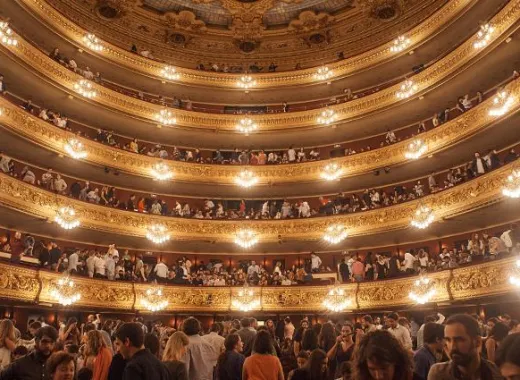
Barcelona's opera house, the Gran Teatre del Liceu, was founded on the Rambla in 1847 and has continued over the years to fulfil its role as a culture and arts centre and one of the symbols of the city.

Today it is publicly-owned (by the Government of Catalonia, Barcelona City Council, Barcelona Provincial Council and the Ministerio de Educación, Cultura y Deporte) and administered by the Fundació del Gran Teatre del Liceu which, in addition to the aforementioned bodies, incorporates the Patronage Council and the Societat del Gran Teatre del Liceu (the old society of owners).
 

Origins: From 1837 to 1847

The Liceu evolved out of the Sociedad Dramática de Aficionados (Society of theatre-lovers) set up in 1837 at the instigation of Manuel Gibert in the former convent of Montsió by members of the National Militia, an organization of armed citizens with liberal leanings.
Barcelona's economy and population were growing fast at the time and the city needed a music conservatory. This led to the conversion of the Sociedad Dramática into the Liceo Filármonico Dramático Barcelonés de S.M. la Reina Isabel II (Barcelona Dramatic and Philharmonic Lyceum of HM Queen Isabel II).  In addition to its theatrical activities, the new organization cultivated Italian-style singing and music.
 

The building on the Rambla

The original building was solemnly opened on 4 April 1847. The plans had been drawn up by Miquel Garriga i Roca, subsequently assisted by Josep Oriol Mestres. The project was funded by selling shares, which meant that many of the boxes and seats were to be privately owned. The shareholders formed the Societat del Gran Teatre del Liceu, known as the “Societat de Propietaris” (Society of Owners),  which was in sole charge of running the Gran Teatre del Liceu from 1855 onwards, after it was legally separated from the Conservatori del Gran Teatre del Liceu.
The theatre was operated by impresarios who were given a concession to stage a specific number of productions in exchange for the proceeds from the sale of tickets not reserved for the Societat itself. This system was to endure until 1980.
 

The creation of the Consortium

By the last quarter of the 20th century this management system was no longer viable. In 1980, to avert the danger of the disappearance of an institution of such worldwide cultural renown, the Generalitat  Catalonia's first government in modern times – set up a consortium, the Consorci del Gran Teatre del Liceu, which also incorporated Barcelona City Council and the Societat del Gran Teatre del Liceu. Barcelona Provincial Council joined the Consortium in 1985, followed by the Spanish Ministry of Culture in 1986. From then on the Consortium took over operation of the theatre.


Accomodation

Buy now

Gift vouchers

Gift someone an unforgettable night at the opera.
Choose a gift coupon and let them pick the performance they love—music, drama, and world-class artistry, all in one elegant experience.
Barcelona Opera Tickets
Facebook
Payment
© 2026 RM EUROPA TICKET GmbH
Whatsapp