


en
en v
Phone
Cart0 Tickets
Total: 0
Account
Calendar
Search
Menu

La rosa dels set pètals

VenueGran Teatre del Liceu
CalendarFri 04 Jun 2027 - Sun 06 Jun 2027
Synopsis/Details

La rosa dels set pètals – Lucas and Tomàs Peire


'La rosa dels set pètals' speaks about memory, identity and freedom.

With more than 150,000 inhabitants, the seven neighborhoods of the Sant Andreu District -El Congrés i els Indians, Navas, La Sagrera, Sant Andreu de Palomar, La Trinitat Vella, Baró de Viver and El Bon Pastor- form a Barcelona territory with a strong historical, industrial and cultural identity from the 19th and 20th centuries, and play a prominent role in the participation and creation of the opera La rosa dels set pètals.

The Liceu produces a second community opera of new creation with the Sant Andreu district, following La gata perduda (2022/23). The work, with libretto by Blanca Bardagil, music by Tomàs Peire and Lucas Peire, stage direction by Israel Solà and musical direction by Manel Valdivieso, features the active participation of local residents and organizations in the district, with the support of Barcelona City Council, and reflects the importance of reclaiming historical memory and the associative and cultural tradition of Sant Andreu.


The Liceu Opera Prima community artistic creation line is a multidimensional project that combines the creation of an opera with a three-year community mediation process. It collaborates with residents, organizations and facilities in a given area to bring citizens closer to operatic creation through activities and dynamics within the LiceuApropa and LiceuAprèn programmes. Launched in 2018, it seeks to promote cultural rights and foster equality, diversity and equity in access to opera. Active participation covers several stages of creation —writing, performance, communication and technical construction— and culminates in a performance at the Liceu’s Main Hall, consolidating opera as an inclusive project sensitive to contemporary realities.

The opera is supported by the European technological research project AMPLIFY, which aims to facilitate a digital transition in the cultural and creative industries through newly created technological tools at the service of creativity, inclusion and citizens’ quality of life.

Opera Prima positions itself as a unique proposal in the operatic landscape. Its commitment to new creation opera, conceived with and from the community, is an example of how art can become a driver of social transformation, a creative stimulus and a space for cultural innovation and collective celebration.

Cast

Violeta and Llibertat: Lidia Vinyes-Curtis

Adult Amèlia: Dolors Aldea

Young Amèlia: Mercedes Gancedo

Remei: Laura Vila

Andrea: Laura Brasó

Andreu and Raimon: Marc Sala 


Stage direction - Israel Solà

Dramaturgy (original libretto) - Blanca Bardagil

Set design - Bibiana Puigdefàbregas

Costume design - Joana Martí

Lighting - Rodrigo Ortega

Movement design - Laia Duran

Production - Gran Teatre del Liceu

Choir Coordination - Buia Reixach

Conductor - Manel Valdivieso

Composition - Tomàs Peire and Lucas Peire

Venue
Gran Teatre del Liceu

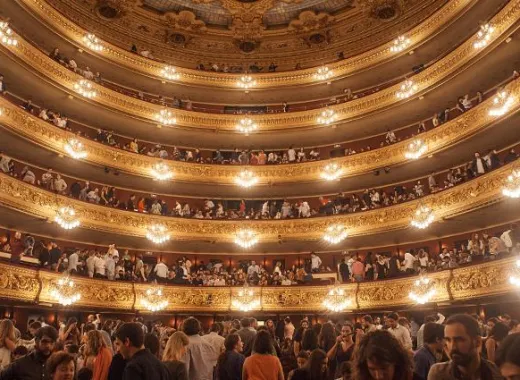
Barcelona's opera house, the Gran Teatre del Liceu, was founded on the Rambla in 1847 and has continued over the years to fulfil its role as a culture and arts centre and one of the symbols of the city.

Today it is publicly-owned (by the Government of Catalonia, Barcelona City Council, Barcelona Provincial Council and the Ministerio de Educación, Cultura y Deporte) and administered by the Fundació del Gran Teatre del Liceu which, in addition to the aforementioned bodies, incorporates the Patronage Council and the Societat del Gran Teatre del Liceu (the old society of owners).
 

Origins: From 1837 to 1847

The Liceu evolved out of the Sociedad Dramática de Aficionados (Society of theatre-lovers) set up in 1837 at the instigation of Manuel Gibert in the former convent of Montsió by members of the National Militia, an organization of armed citizens with liberal leanings.
Barcelona's economy and population were growing fast at the time and the city needed a music conservatory. This led to the conversion of the Sociedad Dramática into the Liceo Filármonico Dramático Barcelonés de S.M. la Reina Isabel II (Barcelona Dramatic and Philharmonic Lyceum of HM Queen Isabel II).  In addition to its theatrical activities, the new organization cultivated Italian-style singing and music.
 

The building on the Rambla

The original building was solemnly opened on 4 April 1847. The plans had been drawn up by Miquel Garriga i Roca, subsequently assisted by Josep Oriol Mestres. The project was funded by selling shares, which meant that many of the boxes and seats were to be privately owned. The shareholders formed the Societat del Gran Teatre del Liceu, known as the “Societat de Propietaris” (Society of Owners),  which was in sole charge of running the Gran Teatre del Liceu from 1855 onwards, after it was legally separated from the Conservatori del Gran Teatre del Liceu.
The theatre was operated by impresarios who were given a concession to stage a specific number of productions in exchange for the proceeds from the sale of tickets not reserved for the Societat itself. This system was to endure until 1980.
 

The creation of the Consortium

By the last quarter of the 20th century this management system was no longer viable. In 1980, to avert the danger of the disappearance of an institution of such worldwide cultural renown, the Generalitat  Catalonia's first government in modern times – set up a consortium, the Consorci del Gran Teatre del Liceu, which also incorporated Barcelona City Council and the Societat del Gran Teatre del Liceu. Barcelona Provincial Council joined the Consortium in 1985, followed by the Spanish Ministry of Culture in 1986. From then on the Consortium took over operation of the theatre.


Accomodation

Buy now

Gift vouchers

Gift someone an unforgettable night at the opera.
Choose a gift coupon and let them pick the performance they love—music, drama, and world-class artistry, all in one elegant experience.
Barcelona Opera Tickets
Facebook
Payment
© 2026 RM EUROPA TICKET GmbH
Whatsapp